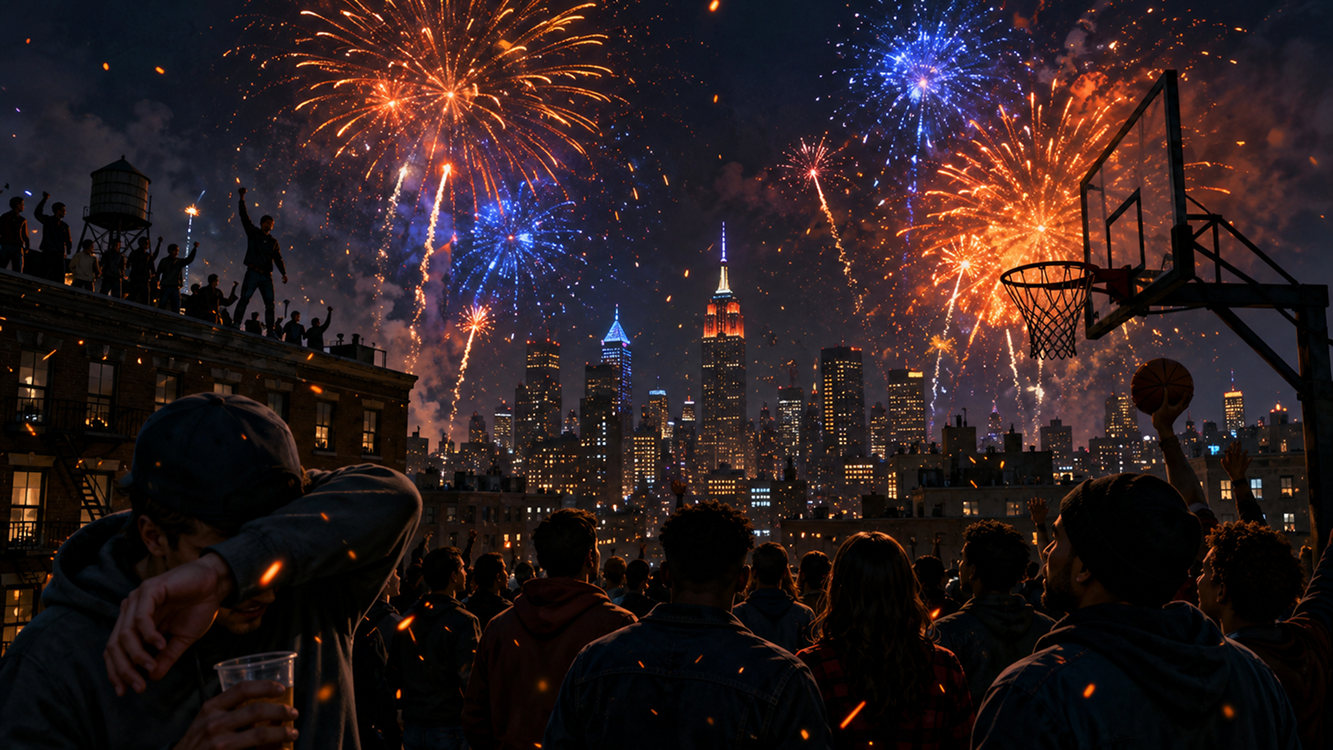
Last week, the Knicks won their first title in 53 years, and the city was bursting with joy. Literally. The fireworks went up the instant the buzzer sounded. Then a dozen more, orange and blue, blooming over the rooftops, embers trailing low enough that you'd cover your drink on reflex, ash drifting onto shoulders three blocks from wherever the things were launched. Half of New York was standing under a sky of falling fire.
Somewhere under that flaming canopy, the litigator part of my brain woke up. I am standing beneath live explosives, lit by someone I have never met, and if one of those shells malfunctioned and fell into the crowd, who is responsible?
My instinct pointed to strict liability. Fireworks feel like the textbook activity so dangerous that whoever sets them off should simply pay for the harm, fault or no fault. But the answer is messier — and more interesting — than that. It turns on two things: where you were standing (i.e., which state's law applies), and whether the display was legal and permitted.
What "abnormally dangerous" means
In tort law, some activities are treated as so hazardous that the person undertaking them is strictly liable for any resulting harm, even if every reasonable precaution was taken. Courts sort activities onto that list using the factors in the Restatement (Second) of Torts § 520: how high the risk is, whether reasonable care can eliminate it, whether the activity is a matter of common usage, whether it fits the place, and what value it has to the community.
Detonating dynamite is a classic example of an activity subject to strict liability. Fireworks, you would assume, are right behind it.
But the doctrine does not ask only whether an activity looks dangerous. It asks whether the danger persists even when the activity is done carefully. That question decides almost every case below.
The majority view: lawful public fireworks are negligence cases
Most courts that have considered lawful public displays have rejected strict liability. The most vivid modern example comes from a farm.
In Maryland, a church-sponsored fireworks show startled a neighboring dairy herd into a stampede. Cattle died. The farmer sued on strict liability, arguing that the fireworks display was abnormally dangerous. The court disagreed, reasoning that Maryland’s permitting scheme was designed to reduce the high risks fireworks pose (mishandling, misfires, malfunctions) and that lawful public displays are a common occurrence. Toms v. Calvary Assembly of God, Inc., 132 A.3d 866 (Md. 2016).
These reasons matter a great deal. The Maryland court did not say that fireworks are safe. It said the law should treat a permitted, regulated display as an activity whose risks can be meaningfully reduced by licensing, supervision, and compliance with safety rules. Framed that way, the case sounds in negligence: Did the operator do what a reasonably careful operator should have done?
That rule traces to a 1960 Pennsylvania decision holding that a public display "handled by a competent operator in a reasonably safe area and properly supervised" is not ultrahazardous. Haddon v. Lotito, 161 A.2d 160 (Pa. 1960). An Illinois court reached the same result by working through each Restatement (Second) § 520 factor: reasonable care meaningfully reduces the risk, municipal displays are a matter of common usage, and a Fourth of July show's value is not outweighed by its danger. Cadena v. Chicago Fireworks Manufacturing Co., 297 Ill. App. 3d 945 (Ill. App. Ct. 1998) ("[W]e determine, based on the fact that the general public enjoys fireworks displays to celebrate every July 4, they are of some social utility to communities").
California adds another layer to the analysis. In Ramsey, the plaintiffs were injured by aerial bombs at a public display but they were not mere spectators; they were employed by the pyrotechnic operator of the display. The plaintiffs sued the company that had manufactured the shells, among others. The manufacturer defendants floated a clever defense: if the display itself was "ultrahazardous," then the workers — who had knowingly taken part in it — could be barred from recovering at all. The court rejected the ultrahazardous characterization on two grounds: fireworks displays are a matter of common usage, and the risk of serious harm could have been eliminated had the shells been manufactured non-negligently. Ramsey v. Marutamaya Ogatsu Fireworks Co., 72 Cal. App. 3d 516 (Cal. Ct. App. 1977).
A New York case illustrates this rule in action. In Evarts, a spectator was struck after a six-inch shell suffered a "blow by" — a flaw in the time-fuse seal that let the lift charge bypass the fuse — detonating inside the mortar and sending another shell into the crowd. The court did not apply strict liability. It held the operators to "a high degree of care" and sent the negligence claim to trial, while dismissing the strict products claim against them because they hadn't manufactured the defective shell. Evarts v. Pyro Engineering, Inc., 117 A.D.3d 1148 (N.Y. App. Div. 2014). To win, the spectator had to prove the operators were careless — being hurt wasn't enough on its own.
The minority view: when no one can prove what went wrong
A minority of courts go the other way, and Washington is the best example. Its reasoning starts with the same worry you'd have standing in that crowd. The majority rule asks the injured spectator to identify the careless act, such as a shell fired at the wrong angle or a mortar placed too close. But a misfire tends to destroy the evidence of its cause. The shell that caused the harm has, by definition, blown itself apart and taken the proof of what went wrong with it.
So when a shell misfired at a July display and injured two bystanders, the Washington Supreme Court declined to leave that proof problem with the victims. It held that conducting a public fireworks display is an abnormally dangerous activity and imposed strict liability on the pyrotechnician. Klein v. Pyrodyne Corp., 810 P.2d 917 (Wash. 1991)
The court read the § 520 factors the opposite way from the majority view. Firing aerial shells around crowds, it held, presents an ineliminably high risk of serious injury — one that no amount of care at the show fully mitigates. Staging a licensed pyrotechnic display is uncommon because the average person doesn't do it. And Washington's own fireworks statute already required operators to cover all resulting damage regardless of fault, which the court read as a legislative choice to put the loss on the operator.
That sets up the sharpest point in the split. Confronted with the possibility that a manufacturer's defect caused the misfire — a party the spectator usually can't identify, let alone sue — the court held the pyrotechnician strictly liable anyway, because a manufacturer's negligence is a foreseeable risk of putting on the show, and the loss should fall on the party best able to plan for it and insure against it.
So Ramsey treats a possible manufacturing defect as a reason not to call the display ultrahazardous; Klein treats the same uncertainty as a reason for strict liability. The majority asks the injured person to prove negligence anyway. Washington asks why the injured person should bear the loss when the evidence disappeared with the shell.
Outside permitted displays, the analysis shifts
The majority rule addresses fireworks displays that are lawful, permitted, and professionally run. It says nothing about what happens when someone launches fireworks privately, illegally, or without safeguards.
Connecticut draws the line. In Lipka, the court addressed an illegal, unpermitted display. It acknowledged the cases rejecting strict liability for lawful public shows, but held that an illegal display is an abnormally dangerous activity subject to strict liability. The court reasoned that unlawful displays inevitably increase the risk, and someone who deliberately sets off explosives knowing it's illegal has given the law reason enough to put the loss on him. Lipka v. Dilungo, 2000 Conn. Super. Ct. 4864 (Conn. Super. Ct. 2000). Strip away the permits, the professionals, and the safe distances the majority leans on, and a display starts to look less like a civic event and more like someone introducing explosives into a neighborhood.
A recent Wisconsin federal case draws the same line but comes out the other way. Harrington involved a private display in which the injured plaintiff had helped handle the fireworks and tried to hold the defendants strictly liable for the harm he suffered. The court held the display was not abnormally dangerous because reasonable care (obtaining a permit, the label instructions, distance, a proper launch setup) could minimize the risk, and an activity does not become abnormally dangerous just because it was carried out negligently. An abnormally dangerous activity, the court explained, is one where "the risk of harm remains unreasonably high no matter how carefully it is undertaken." Harrington v. Nordentoft, No. 2:21-cv-01182 (E.D. Wis. Jun. 15, 2023).
Across these cases, the doctrine begins to take shape. Lawful public displays usually fall on the negligence side. Illegal displays may fall on the strict-liability side. Private displays go either way, depending on the jurisdiction and the facts.
So who pays when it goes wrong?
It depends on where you were standing. In most states, a hurt spectator has to prove negligence. In Washington and in courts that follow Klein, the operator pays regardless of fault, on the theory that the person who can't prove what went wrong shouldn't bear the loss. Step outside the permitted show, and the picture shifts again: an illegal display can tip into strict liability, a private one usually stays in negligence. But every one of these cases raises the same question: could reasonable care have controlled the risk, and if not, who absorbs the harm?
And that's the part I find almost unreasonably satisfying. A multi-state split over fireworks liability is exactly the kind of question I'd have let die as a litigator. Chasing it down wasn't worth the hours unless a client walked in with a fireworks problem and bad luck. It remained a shower thought.
This time, I ran it through Midpage and had the split mapped, grounded in real cases, in the time it would have taken to think of keyword searches. With Midpage, every case above links to the opinion it's drawn from. That's the best part: I don't have to take the analysis on faith. I can quickly review the cases themselves, one click away — which, for anyone who has been burned by a citation that turned out not to say what they were cited for, is a game-changer.
Curious about a legal question?