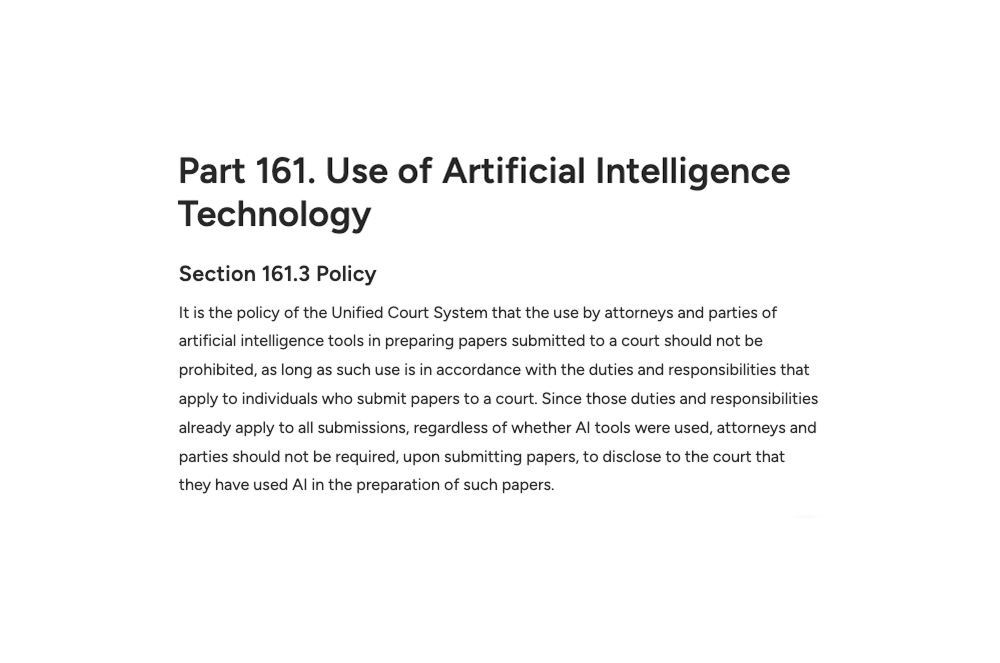
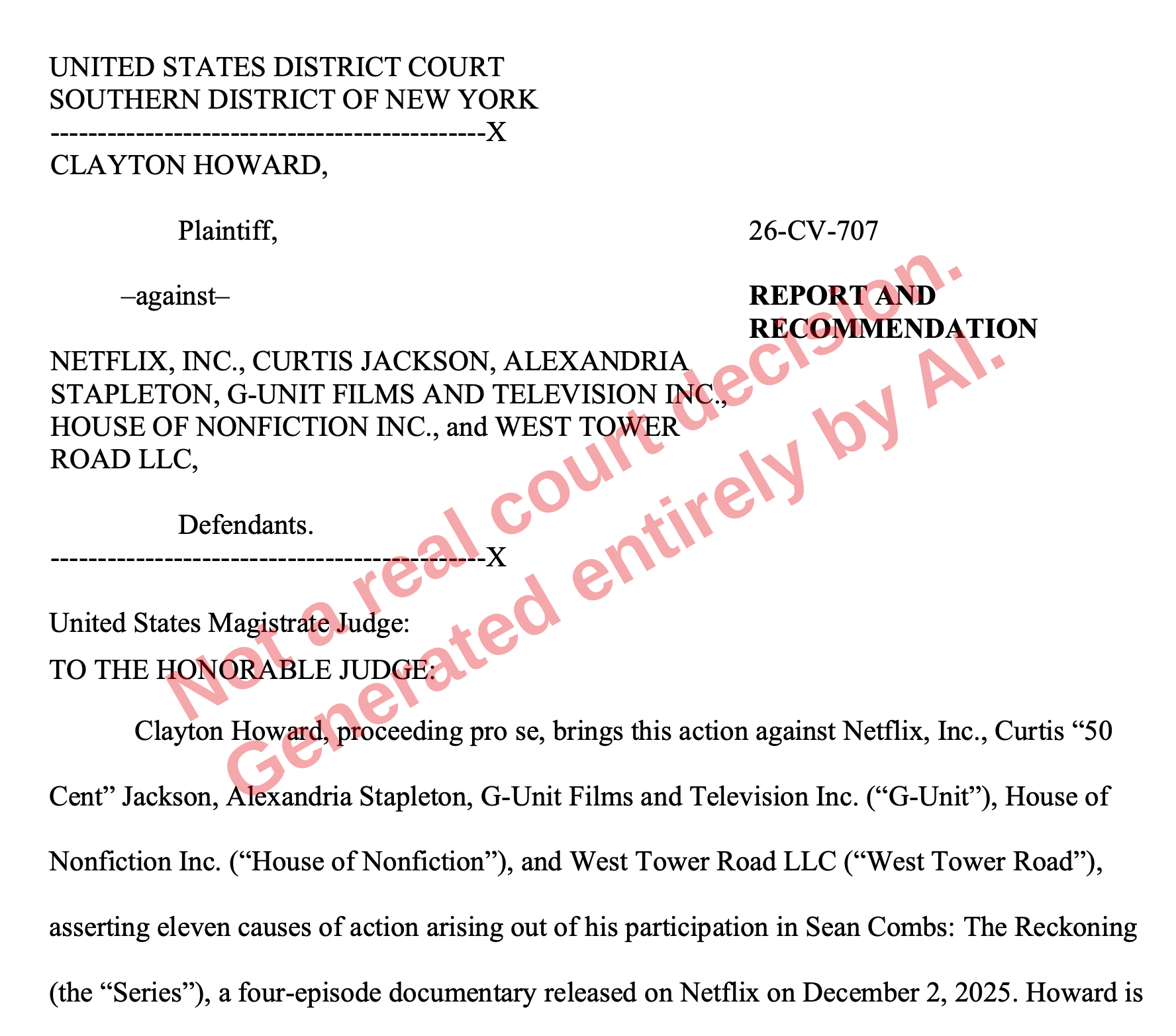
We had Claude Fable 5 draft the magistrate's recommendation on a live S.D.N.Y. motion to dismiss. Then it verified every cited case using Midpage. Judge the result for yourself — read the recommendation.
Every few weeks, another lawyer makes the news for filing a brief built on hallucinated cases that don't exist. The reactionary take — that AI can't be trusted with legal work — is overblown and fundamentally misses the best uses of AI. We have found that an agent asked to recall the law from memory will invent it, whereas an agent with access to a well-constructed case law corpus can research, analyze, and write good briefs.
Don’t take our word for it. We gave one of the newest frontier models a real, undecided motion and a connection to real case law, and asked it to read the record, apply the law, and recommend a result as if it were the decision maker. The resulting draft blew us away.
The Setup
We connected Claude Fable 5 to Midpage's legal research and PACER tools and prompted it to write the report and recommendation on the motion to dismiss in Howard v. Netflix, No. 1:26-cv-00707 (S.D.N.Y.). At the time of writing, the motion is fully briefed but not yet decided.
A note on the case, so you can judge the output for yourself. The plaintiff, proceeding pro se, appeared in Sean Combs: The Reckoning, the four-part Netflix documentary released last December produced by Curtis "50 Cent" Jackson.
Howard alleges the producers promised to tell his "complete and true story" and then edited his account to protect the person he identifies as his primary trafficker, and that Netflix falsely claimed it hadn't paid participants when he received $2,000.
On those facts, the complaint pleads eleven causes of action. The wrinkle: it preemptively attacks an appearance release the plaintiff signed in September 2024, giving up "any and all claims … of any kind or nature whatsoever" relating to the documentary.
Netflix and its co-defendants moved to dismiss the complaint in full, relying primarily on that release.
The Output
The agent wrote a 26-page recommendation to grant the motion and dismiss with prejudice, written in the structure, sequence, and register of an actual S.D.N.Y. report and recommendation by a magistrate judge.
Casting the task as the recommendation a magistrate judge would write — rather than "analyze this complaint" — puts the agent in a more disciplined, claim-by-claim mode and tends to produce tighter reasoning. It is not a court document, and we don't present it as one. The case is real and public, but the recommendation is entirely the agent's work.
We also directed the agent to verify every citation in Midpage before returning the draft, and we ran the load-bearing authorities through Midpage's analyzer, which reads the actual opinion. They held up.
The Analysis
AI output almost always “reads well,” but we know fluency can mislead. A running database of decisions catching AI-hallucinated citations now lists more than 1,600 worldwide, and is growing by several a day. So fluency alone proves nothing. What persuaded us is the nuanced reasoning that only shows up if the agent actually read the record and did the work.
Here's a claim-by-claim map of the key recommendations with the supporting reasoning and key authority:
A few nuances — none decisive to the result — are what convinced us the analysis was real rather than fluent guesswork.
The production employee whose emails anchor the fraud and RICO theories is repeatedly labeled a “Defendant” in the complaint, yet she was never named as a party. The recommendation flags it and corrects the record (page 5).
It also decided only what it had to. Whether the release even reaches the defamation and federal claims is a close question; the agent raises it, then declines to resolve it because those claims fail on the merits regardless (page 12) — exhibiting the restraint of a decision-maker who answers the question in front of it and no more.
And it reasoned its way to the disposition instead of defaulting to one. Starting from the rule that a pro se plaintiff usually gets a chance to replead, it worked through why amendment would be futile here rather than reflexively granting or denying leave (page 25). Reasoning to that conclusion — instead of assuming it — takes real legal analysis, not pattern matching.
Conclusion
We didn't run this experiment to read tea leaves or feed prediction markets, and this is not a claim that the model "called it right." It's also not a claim that agents will automate judgment.
What the agent produced is a first draft — a good one — that still must be reviewed by a lawyer or jurist before it is signed and filed. The takeaway we’re excited about is sharper and more durable: the newest frontier models have improved at analytical drafting, and, when paired with grounded case law research through Midpage, that’s a genuinely useful tool for lawyers and courts.
So, setting the eventual outcome aside, we'd like your read. How does this stack up against the motions to dismiss you've navigated? Where would you push back? Drop us a line — we'd like to hear from practitioners.