How Midpage Builds High Quality Data
Commercially available datasets didn’t meet our expectations. So we built one from scratch.
Legal data is controlled by publishing houses who prevent you from building new services on top of it. The efforts from libraries and open source make data more accessible but are messy and incomplete.
Midpage offers what others failed to: legal data that is comprehensive, reliable, and designed for humans and agents alike.
One standardized format.
No raw PDFs or inconsistent HTML. Our 16M+ opinions are easy-to-read and interactive.
US v. Woodfork
ST. EVE, Circuit Judge. In 2018, a state police officer sought and obtained a warrant to search Defendant Edward Woodfork’s home based on the officer’s orchestration of several controlled-buy drug transactions involving Woodfork.
                               In the

    United States Court of Appeals
                For the Seventh Circuit
                     ____________________

No. 20-3415
UNITED STATES OF AMERICA,
                                                   Plaintiff-Appellee,
                                 v.

EDWARD WOODFORK,
                                               Defendant-Appellant.
                     ____________________

         Appeal from the United States District Court for the
                     Central District of Illinois.
           No. 2:18-cr-20060 — Michael M. Mihm, Judge.
                     ____________________

     ARGUED APRIL 22, 2021 — DECIDED JUNE 4, 2021
High fidelity data.
Section headings, footnotes, block quotes, and pin cites are preserved and rendered in every opinion.
Because the district court applied § 42 of the Third Restatement in its duty analysis, we will too.2 Section 42 provides that:
*1117 An actor who undertakes to render services to another and who knows or should know that the services will reduce the risk of physical harm to the other has a duty of reasonable care to the other in conducting the undertaking if:
(a) the failure to exercise such care increases the risk of harm beyond that which existed without the undertaking, or
(b) the person to whom the services are rendered or another relies on the actor’s exercising reasonable care in the undertaking.
Restatement (Third) of Torts: Phys. & Emot. Harm § 42 (A.L.I. 2012).
The district court reasoned that Thomas and Eyerly-Ball’s actions in this case did not trigger a duty under § 42 because the services they rendered did not subject Jordan to any greater risk than he would have faced had they provided no services at all:
In this case, Thomas’s services consisted of an interview with Jordan. After the interview, Thomas arranged for a telehealth appointment for Jordan later that afternoon…
      Because the district court applied § 42 of the Third Restatement in its
duty analysis, we will too. 2  Section 42 provides that:
An actor who undertakes to render services to another and who knows or should
know that the services will reduce the risk of physical harm to the other has a
duty of reasonable care to the other in conducting the undertaking if:
             (a) the failure to exercise such care increases the risk of harm
             beyond that which existed without the undertaking, or

1 Sections 323 and 42 differ from §§ 324A and 43 in one way that is potentially
relevant here: they always require increased risk or reliance, where §§ 324A and
43 can be satisfied by the mere showing that the defendant has undertaken a duty
owed by another to the plaintiff. . . . 2 The Iowa Supreme Court has applied
§ 42’s predecessor section—Restatement (Second) of Torts § 323 (A.L.I.
1965)—in conducting duty analyses. See Jain v. State, 617 N.W.2d 293, 299
(Iowa 2000) (collecting cases). (b) the person to whom the services are rendered
or another relies on the actor’s exercising reasonable care in the undertaking.
Restatement (Third) of Torts: Phys. & Emot. Harm § 42 (A.L.I. 2012).
Enriched metadata.
111M+ links between opinions, including treatment data for negatively treated cases.
Whether the parties have agreed to arbitrate is generally a question of state contract law. See Specht, 306 F.3d at 27. The district court applied Connecticut law on the question of contract formation, see Edmundson, 642 F. Supp. 3d at 265-66, and the parties do not challenge that decision on appeal. Nonetheless, as the parties acknowledge, traditional contract formation *703 law does not vary meaningfully from state to state, Appellant’s Br. at 22 n.2; Appellee’s Br. at 25 n.8, and therefore, our precedents determining the enforceability of arbitration provisions according to the contract-law principles of other states may also be relevant to this dispute. See, e.g., Schnabel v. Trilegiant Corp., 697 F.3d 110, 119 (2d Cir. 2012) (noting that “Connecticut and California apply substantially similar rules for determining whether the parties have mutually assented to a contract term.”); Meyer v. Uber Techs., Inc., 868 F.3d 66, 74 (2d Cir. 2017) (noting the same about New York and California). Accordingly, we need not and do not limit ourselves to Connecticut law in resolving this question of arbitrability.2
             Whether the parties have agreed to arbitrate is generally a question
of state contract law. See Specht, 306 F.3d at 27. The district court applied
Connecticut law on the question of contract formation, see Edmundson, 642 F.
Supp. 3d at 265-66, and the parties do not challenge that decision on appeal.
Nonetheless, as the parties acknowledge, traditional contract formation law does
not vary meaningfully from state to state, Appellant's Br. at 22 n.2; Appellee's Br.
at 25 n.8, and therefore, our precedents determining the enforceability of
arbitration provisions according to the contract-law principles of other states
may also be relevant to this dispute. See, e.g., Schnabel v. Trilegiant Corp., 697 F.3d
110, 119 (2d Cir. 2012) (noting that "Connecticut and California apply
substantially similar rules for determining whether the parties have mutually
assented to a contract term."); Meyer v. Uber Techs., Inc., 868 F.3d 66, 74 (2d Cir.
2017) (noting the same about New York and California). Accordingly, we need
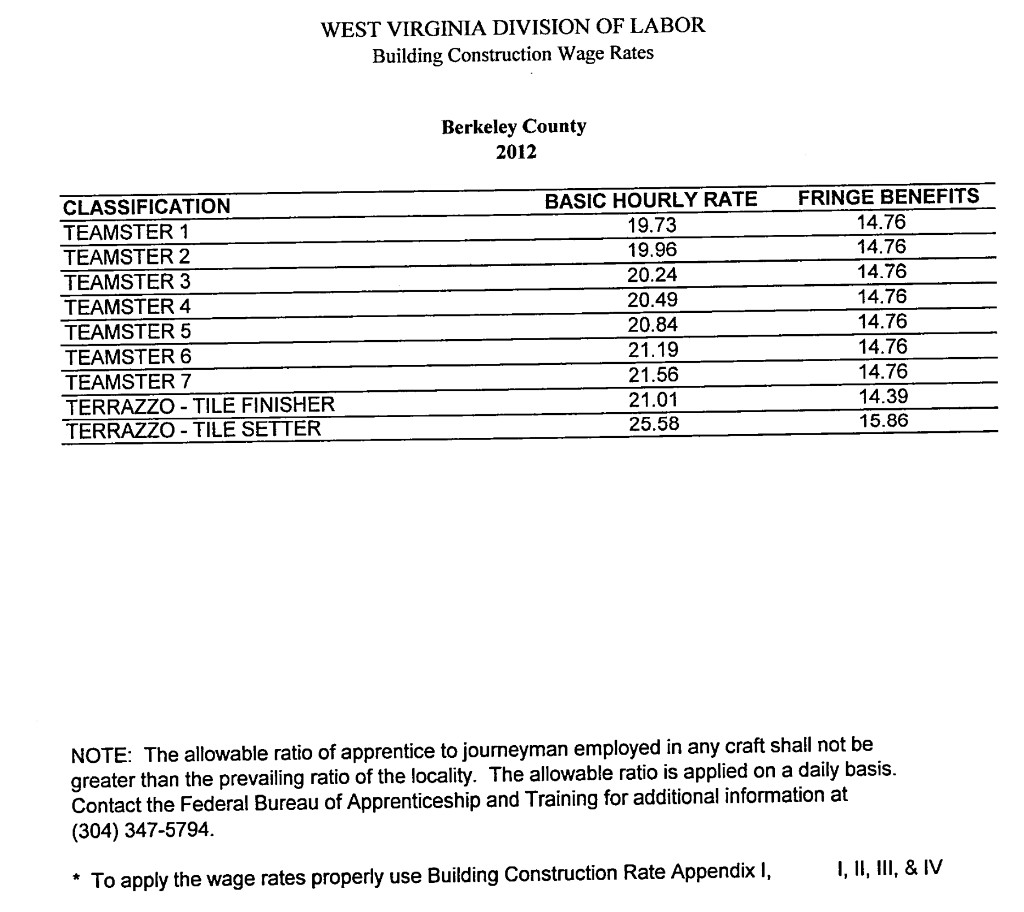
Structured laws and regulations.
Versioned statutes and regulations, preserving formatting for images, tables, and sub-sections.
2012 Prevailing Wage Rates Revisions
| Classification | Basic Hourly Rate | Fringe Benefits |
|---|---|---|
| TEAMSTER 1 | 19.73 | 14.76 |
| TEAMSTER 2 | 19.96 | 14.76 |
| TEAMSTER 3 | 20.24 | 14.76 |
| TEAMSTER 4 | 20.49 | 14.76 |
| TEAMSTER 5 | 20.84 | 14.76 |
| TEAMSTER 6 | 21.19 | 14.76 |
| TEAMSTER 7 | 21.56 | 14.76 |
| TERRAZZO - TILE FINISHER | 21.01 | 14.39 |
| TERRAZZO - TILE SETTER | 25.58 | 15.86 |