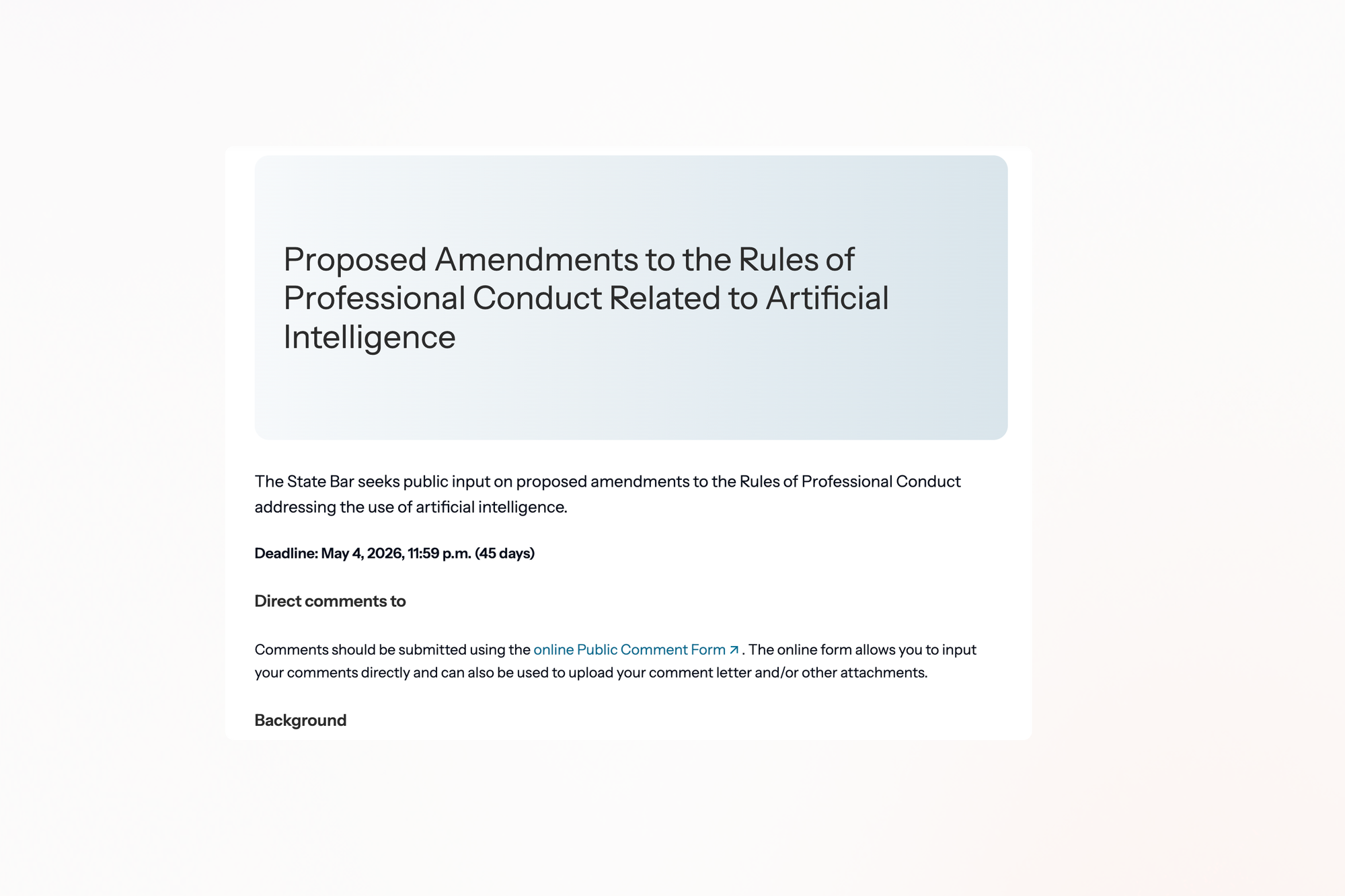
The State Bar of California recently invited public comment on proposed amendments to its Rules of Professional Conduct addressing artificial intelligence. The proposal touches several rules, but one in particular caught our attention: the proposed change to the duty of candor.
California tends to set the tone on these questions, so how the Bar resolves this one will likely shape how other courts and regulators approach their own rules, and how lawyers think about the duty of candor for years to come. It's worth remembering that the duty itself isn't new: lawyers were sanctioned for citing fake, overruled, and mischaracterized cases long before ChatGPT, because the obligation has always applied to every citation, from every source.
Earlier this month, we submitted a public comment in response. We support the rulemaking and appreciate the Bar’s work on these difficult issues. Our comment respectfully suggests reconsidering the framing of proposed Comment [3] to Rule 3.3:
A lawyer’s duty of candor towards the tribunal includes the obligation to verify the accuracy and existence of cited authorities, including ensuring no cited authority is fabricated, misstated, or taken out of context, before submission to a tribunal, including any cited authorities generated or assisted by artificial intelligence or other technological tools.
We offered two observations on the proposed language.
First, the comment singles out AI. The proposal would emphasize verification of authorities “generated or assisted by artificial intelligence or other technological tools.” The duty of candor, however, applies uniformly — to every authority a lawyer puts before a tribunal, whatever its provenance. Foregrounding the technology may invite a negative inference—that non-AI citations carry a lesser obligation—and shift focus from the controlling question: did the lawyer exercise reasonable diligence and personally verify the authority?
Second, the comment treats “AI” as a single category. The hallucination problem driving this rulemaking is principally a feature of ungrounded AI use. Grounded systems, also called retrieval-augmented generation, or RAG, retrieve source material from a defined corpus first, then constrain the model’s output to that material. This substantially reduces the risk of fabrication, though it does not eliminate it. The architectural difference matters, and the empirical evidence is beginning to bear that out: a recent randomized controlled trial found that work produced with retrieval-augmented research tools contained substantially fewer hallucinated citations than work produced with ungrounded reasoning models.
These distinctions, in our view, belong in the Bar’s Practical Guidance, where they can evolve alongside the technology, rather than in a rule comment that will be difficult to amend once adopted. The emerging consensus, reflected in ABA Formal Opinion 512, is becoming clearer: AI is permissible; the lawyer must verify; the depth of verification depends on the tool and the task. A rule anchored to the lawyer’s verification duty, paired with practical guidance that can keep pace with the evolution of AI tools, seems to us the more durable approach.
Our comment letter proposes specific revisions to the language. As a company that builds legal AI, we have an obvious interest in how this rule is framed. We are also interested in getting the framing right, and that is the spirit in which we offered our comment.